


Start by measuring your room’s length and width, then multiply for square footage.
Rooms up to 80 square feet need 24–42 inch fans.
Mid-sized rooms around 100–150 square feet work best with 42–48 inch blades.
Larger spaces over 400 square feet require 56 inches or bigger.
Check your ceiling height—taller ceilings need longer downrods to keep blades 8–9 feet above the floor.
Verify at least 30 inches clearance from walls.
The specifics get more detailed once you dig deeper into your space.
Measure Your Room: The First Sizing Step
Measure Your Room: The First Sizing Step
Before choosing a ceiling fan, you need to know your room’s size.
I’ll walk you through taking accurate measurements. First, grab your tape measure. Measure your room’s length in feet, then width. Multiply these two numbers together for square footage. Simple math, really.
Measure your room’s length and width in feet, then multiply for square footage—simple math.
Do you have adjoining spaces? If your kitchen connects to your living area, measure those too. Add all the square footage together for your total size. This matters.
Why does this matter? Your measurements determine your blade span. A larger room needs a bigger fan blade. Think of it like matching puzzle pieces together.
Write down your final square footage. You’ll need this number next. It’s the foundation for choosing the right ceiling fan for your space.
Match Fan Size to Square Footage (Quick Reference)

Now that you’ve got your square footage, how do you pick the right fan size? I’ll match your measurements to the appropriate blade span for optimal airflow distribution. For rooms up to 8 x 10 feet, choose a 24–42 inch blade span. This keeps things balanced. In spaces up to 12 x 12 feet, I’d recommend 42–48 inches for adequate air circulation throughout. Larger rooms up to 18 x 20 feet need 50 inches or bigger. Really spacious areas over 400 square feet? Go for 56 inches or larger—even 70–72 inches works great. Don’t forget adjoining spaces either. Add their square footage to your total. This helps your fan move air smoothly everywhere it needs to go.
Choose One Large Fan or Multiple Smaller Ones
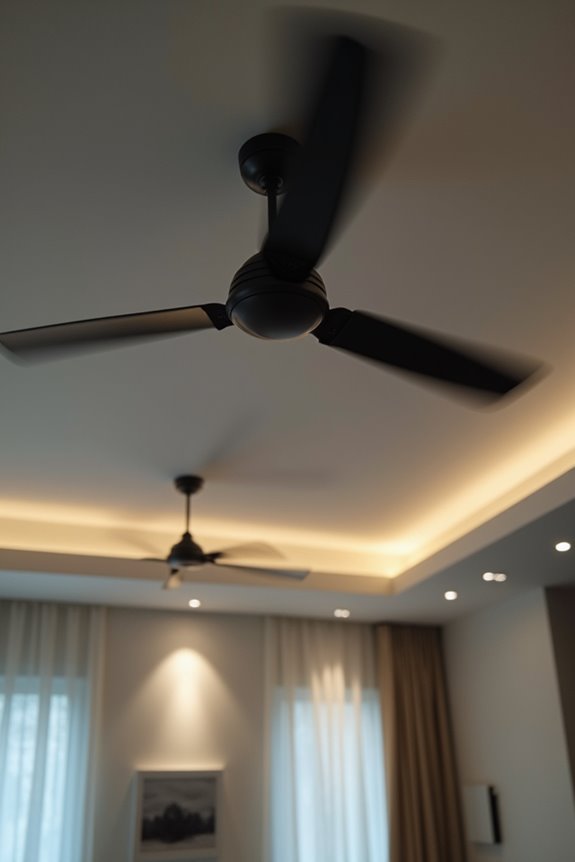
When deciding between one large fan or multiple smaller ones, you’ll need to consider your room’s layout and size. A single large fan works best for open spaces, delivering powerful airflow without cluttering your ceiling. Multiple smaller fans, on the other hand, let you cover different zones separately and create better balance in oddly shaped rooms.
Single Fan Installation Benefits
Should you go big with one fan or spread things out with several smaller ones? I’d recommend going with a single large fan for most situations. Here’s why this ceiling fan size choice works better:
- You’ll get more uniform air distribution throughout your space, eliminating those annoying dead zones where air doesn’t reach.
- A single fan installation keeps your ceiling cleaner and reduces visual clutter from multiple fixtures competing for attention.
- One high-capacity fan with strong CFM ratings can handle mid-to-large rooms more efficiently than juggling several smaller units.
For vaulted ceilings, you can adjust the downrod to maintain optimum hanging height. Larger blade spans work great in great rooms, while 29–36 inch blades suit smaller spaces better. You’ll appreciate the centralized lighting too.
Multiple Fan Distribution Strategy
How do you know when one fan isn’t enough? When your room’s larger than 400 square feet, you’ll want to consider multiple fans. Here’s the thing: your room layout matters most. Two smaller fans work better than cramming one oversized unit into an awkward space. Each fan needs its own zone with at least three to six feet between them. This prevents their airflow from overlapping and cancels out their effectiveness. Think of it like this: fans work best when they’re not fighting each other. For great rooms, one massive 70-inch or 72-inch fan often does the job well. But if your ceiling fan size feels questionable, multiple fans create better coverage. Choose based on your actual room layout, not just square footage.
How Ceiling Height Changes Your Fan Size
Your ceiling height is a key factor that determines both your fan size and how you’ll mount it to your room. I’ll walk you through the standard height requirements, explain what happens with those tricky vaulted or sloped ceilings, and show you exactly which downrod length works best for your space. Getting this right means your fan will circulate air properly while looking proportional to the room.
Standard Ceiling Height Requirements
Ever notice how some ceiling fans look cramped in certain rooms? That’s where ceiling height comes in. I’m here to help you understand how height affects your fan choice and installation.
Here’s what matters:
- 8-foot ceilings need a flush mount (no downrod) for proper clearance
- 9–10 foot ceilings require a 12–18 inch downrod length to position fans correctly
- 11–14 foot ceilings need longer downrods, ranging from 24–60 inches depending on exact height
Standard recommendations place fans 8 to 9 feet from the floor for ideal airflow. When your ceiling exceeds 9 feet, you’ll need a downrod to lower the fan appropriately. Taller ceilings demand longer downrods—24–36 inches for 11–12 feet, and 48–60 inches for 13–14 feet. Getting this right keeps your fan working efficiently and looking proportional in your space.
Vaulted And Sloped Ceilings
What makes vaulted ceilings tricky for fan installation? These sloped surfaces require special equipment. You’ll need angled ceiling adapters to mount your fan securely against the slope. These adapters keep everything level and safe.
Downrod length matters significantly here. I’d recommend increasing it to maintain proper blade clearance and airflow. Longer downrods position your fan higher, away from ceiling angles that could interfere with operation.
Blade span also deserves attention. Larger fans—typically 56 to 72 inches—work better in vaulted spaces. They move air more effectively across these higher areas.
Think of it this way: vaulted ceilings are taller, so you’re working with more vertical space. Matching your fan size and mounting setup to these unique angles helps you achieve balanced airflow throughout your room.
Downrod Length Selection Guide
How high should your fan hang? The downrod length directly impacts your fan’s hanging height, and getting it right matters for both safety and performance. Aiming for roughly seven feet above the floor works best.
Here’s how ceiling height changes your downrod choice:
- 8-foot ceilings: Skip the downrod entirely and use flush-mount instead
- 9–10 foot ceilings: Install a 12–18 inch downrod for proper blade clearance
- 11+ foot ceilings: Use 24–36 inches for standard heights, extending to 72 inches for ceilings 15 feet tall
Selecting the right downrod length provides adequate blade clearance from your head and ceiling. This positioning maximizes airflow efficiency while keeping everyone safe. Taller ceilings simply need longer downrods to maintain that ideal seven-foot hanging distance.
Calculate Downrod Length for Proper Blade Height
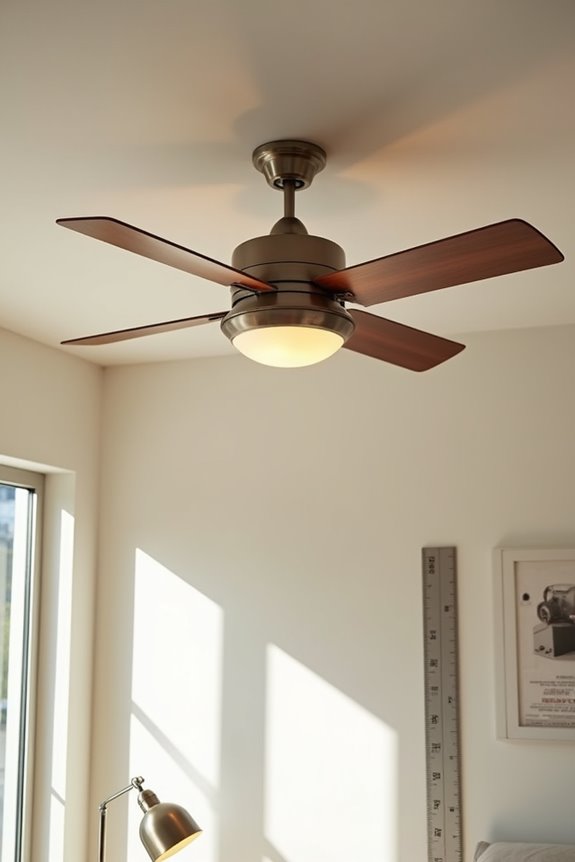
The downrod—that metal rod connecting your fan to the ceiling—positions your blades at the proper height for airflow and safety. Calculate the right downrod length by matching it to your ceiling height.
Use this formula: subtract 9 feet from your ceiling height. If you have a 10-foot ceiling, you need about a 12-inch downrod. Your target blade height is 8–9 feet above the floor for optimal clearance and performance.
| Ceiling Height | Recommended Downrod | Target Blade Height |
|---|---|---|
| 8 feet | Flush mount | 8–9 feet |
| 9–10 feet | 12–18 inches | 8–9 feet |
| 11–12 feet | 24–36 inches | 8–9 feet |
Verify 30 Inches of Clearance From Walls and Obstacles
You’ll need to measure the distance from your fan’s center to each nearby wall and obstacle. I recommend using a tape measure to verify you have at least 30 inches of clearance all around, which keeps the spinning blades safe and allows air to flow freely. If your room’s tight on space, you can always choose a smaller fan or go with a flush-mount style to maintain that essential 30-inch buffer.
Measuring Wall Distance
Proper clearance around your ceiling fan is necessary for safe, efficient operation. I’ll walk you through measuring wall distance so you can install your fan with confidence.
Here’s how I measure clearance:
- Find your fan’s center point on the ceiling and measure horizontally to the nearest wall using a tape measure
- Verify that the distance equals at least 30 inches from blade tips to any obstacle during rotation
- Account for furniture or doorways nearby, making sure blades won’t strike them when spinning
A quick distance check prevents accidents. I always measure twice because accuracy matters. If your clearance falls short, consider installing a flush-mount fan instead. This wall measurement step keeps everyone safe. You’re protecting your family by taking time now.
Obstacle Placement Considerations
How do you know if your ceiling fan’s location will actually work? You’ll want to check for obstacles around your installation spot. I recommend mapping out your blade sweep area first, which is the circular space your fan blades occupy when rotating. Furniture, light fixtures, and cabinetry can all intrude into this zone. You’re aiming for at least 30 inches of clearance from walls and any obstructions. This distance maintains both safety and proper airflow. In rooms with vaulted ceilings, verify your downrod length maintains that essential 30-inch ceiling clearance from angled surfaces. Pay attention to doorways and corners as well. Taking time to assess obstacle placement prevents blade strikes and keeps your fan operating efficiently.
Safety Clearance Standards
Once you’ve identified where your fan will go, it’s time to verify the clearance measurements around it. Proper clearance keeps your fan running safely and efficiently.
Here’s what you’ll need to check:
- Measure 30 inches from the fan’s center to all nearby walls and obstacles
- Confirm blade span doesn’t overlap with furniture, doors, or structural elements during rotation
- Verify clearance remains consistent even with non-lantern light kits or bulky housings attached
This 30-inch minimum standard applies to all fans, regardless of blade span size. You’ll measure from your fan’s center point outward in every direction. Larger blade spans may require extra space depending on your room layout. Following these guidelines prevents interference with airflow and keeps your installation safe and effective.
Adjust for Open Concept Kitchens and Adjacent Spaces

What’s the best way to cool a space where your kitchen flows directly into your dining and living areas? You’ll want a larger fan for open plan layouts. I recommend considering a 70-inch or 72-inch ceiling fan when your combined spaces exceed 400 square feet. This sizing provides effective airflow across all connected zones without leaving any area underserved.
Measure blade tip to blade tip to confirm your fan’s actual size. Position the fan centrally between the cooking, dining, and living areas. This strategy maximizes room sizing efficiency and helps define functional zones naturally. When pairing your fan with other fixtures like dining chandeliers, align their sizes for visual balance. A well-chosen fan creates a cohesive design while keeping your entire open concept kitchen comfortable and connected.
Position Your Fan Over High-Traffic or Primary Use Areas

Where you place your ceiling fan matters just as much as the size you choose. Position your fan strategically for maximum room air circulation in high-traffic areas.
Consider these placement tips:
- Position fans over entryways and main seating zones where you spend the most time
- Center living room fans to align with your primary seating arrangement for even airflow
- Place dining area fans above tables to define the space while maintaining clearance
For open spaces, center your ceiling fan size selection over the largest activity zone. This promotes consistent cooling throughout your home. Remember to maintain at least 30 inches of clearance from walls and doors. Proper positioning maximizes your fan’s effectiveness, helping you feel comfortable in every room.
Avoid These Common Ceiling Fan Sizing Mistakes
Now that you’ve figured out where to place your fan, let’s talk about the mistakes that can derail your whole setup. I see people choose fans that are way too small, which reduces their room airflow and comfort. Ceiling height matters more than you’d think. Low ceilings need flush-mounts, while taller ones require downrods. Mismatching blade span to room size is another common problem.
| Room Size | Recommended Blade Span | Clearance Needed | Fan Type |
|---|---|---|---|
| Under 75 sq ft | 29–36 inches | 30 inches minimum | Flush-mount |
| 75–100 sq ft | 42–48 inches | 30 inches minimum | Standard |
| Over 400 sq ft | 56–70+ inches | 30 inches minimum | Multiple fans |
Pay attention to blade tip clearance as well. Your fan needs at least thirty inches from walls. For great rooms, consider multiple fans to balance everything out properly.
Quick Reference: Fan Sizing by Room Type

Once you’ve determined your room dimensions, matching your fan to your specific room type provides clear guidance. Below are the ceiling fan size recommendations by room category:
- Small bedrooms or offices (up to 8 x 10 ft) need 24–42 inch blade span fans for efficient circulation without overwhelming the space.
- Standard living rooms (up to 12 x 12 ft) work best with 42–48 inch blade spans that balance airflow appropriately.
- Larger spaces like master bedrooms or dens (up to 18 x 20 ft) require 50 inch and larger blade spans for adequate coverage.
Great rooms exceeding 400 square feet typically demand 56–70+ inch blade spans. Calculate your room size first. Then match the blade span accordingly for balanced airflow and proper clearance.